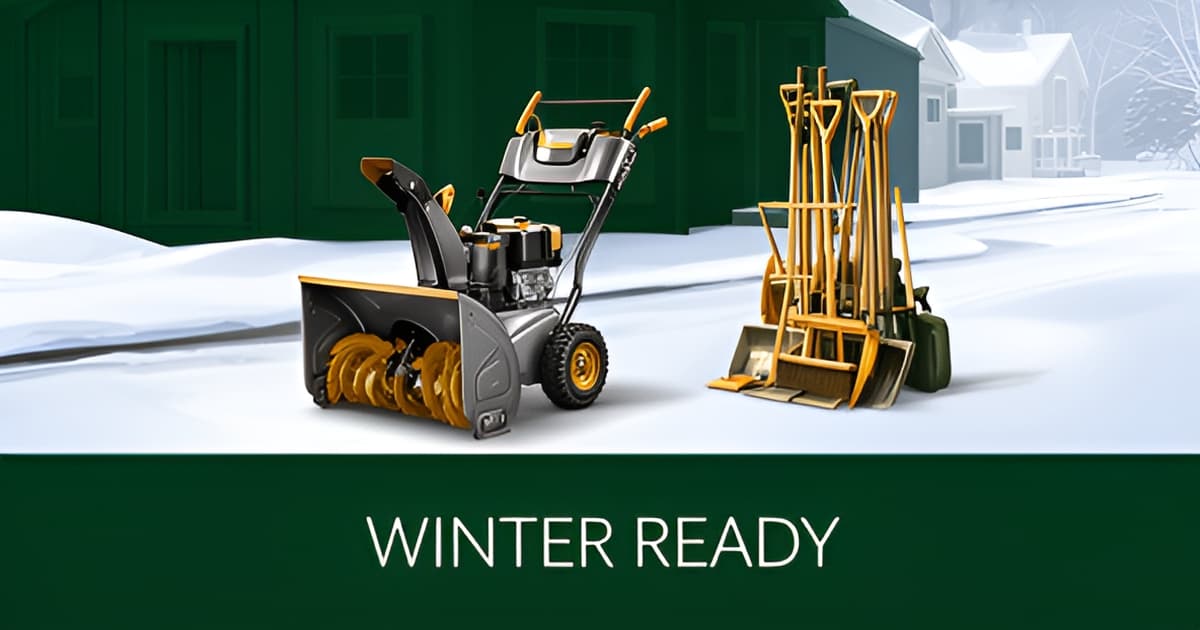
If you own a driveway in Nova Scotia, late October is decision time. Seasonal snow contracts across the province typically run December 1 through March 31, the same window as HRM's overnight winter parking ban on declared nights. Sign too quickly and you might spend four months chasing a contractor who shows up late, leaves a windrow across your driveway entrance, or never sends anything in writing. This week's industry news, oddly enough, offers a better vetting checklist than most homeowner guides do. A Virginia lawn and snow company just earned national safety awards from the National Association of Landscape Professionals (NALP), and Briggs & Stratton launched a commercial engine platform rated to start reliably at 32°F, exactly the temperature band where Nova Scotia shoulder-season work lives. Both stories tell you what to ask before you sign.
Key points
- HRM's overnight winter parking ban runs December 1 to March 31, which is also the standard snow contract window, so contract quality matters for four full months.
- New commercial engines are now explicitly rated to start at 32°F (0°C), and parts availability commitments matter in shoulder-season Nova Scotia.
- The National Association of Landscape Professionals scores safety on verifiable records, including OSHA 300A injury summaries, vehicle insurance claims, and days-away-from-work data, a checklist homeowners can borrow.
- Cordless equipment is now mainstream: lithium-ion held 72.6% of the North American cordless garden market in 2025, and quieter crews are a real customer benefit in dense HRM neighbourhoods.
- A written quote with an exact price, plus automatic rebooking when weather moves a visit, separates accountable operators from the rest.
On October 22, Brandon Rushing Lawn & Garden Care, a company based in Lorton, Virginia, announced it had won two NALP Safety Recognition Awards: Overall Safety Achievement at the Silver level, and a No Days Away From Work Award. What makes this worth your attention isn't the company. It's how the awards get scored. NALP's program doesn't hand out trophies for slogans. Applicants submit their OSHA 300A injury and illness summaries, year-end vehicle insurance claims, accident counts, days-away-from-work data, and a scored safety-program checklist. Those are records a company either has or doesn't have. You can borrow that framework directly. Before signing any snow or property-services contract, ask: is the operator insured, and can they show proof rather than just say yes? Do they track incidents and vehicle claims at all? Do the people who'll actually run a snowblower or plow at 5 a.m. work under a documented safety standard? For a service-partner network model, where vetted local owner-operators do the work under one brand's name, this matters even more. The brand is only as accountable as its vetting process. If a company can't describe how it screens and monitors the crews it sends to your property, that's your answer.
On October 19, Briggs & Stratton's Vanguard brand launched two new vertical-shaft V-Twin engines, at 25.0 and 27.0 gross horsepower, aimed at growing landscaping businesses and large-property owners. One spec stands out for anyone in Atlantic Canada: the solenoid shift starter is rated for reliable starting from 32°F to 120°F. That's 0°C to about 49°C. Nova Scotia's late-fall cleanups, January snow pushes, and early-spring startups all sit at or below that lower limit, and freeze-thaw cycles are the defining feature of our winters. The platform also went through more than 30,000 qualification hours of testing and comes with a three-year warranty, 24-hour parts delivery, and a nationwide dealer network. Why should you care about engine specs you'll never buy? Because equipment reliability is a contract question in disguise. A snow contractor with gear that won't start at minus five is a contractor who misses your 6 a.m. clearing before your commute. Ask your provider what equipment they run, whether it's rated for cold starts, and what happens when something breaks mid-storm. An operator with a parts plan and backup machines will give you a straight answer. One without will change the subject.
Here's the part that separates a real contract from a handshake. Weather in this province doesn't cooperate with schedules, and a good winter agreement says what happens when it doesn't. Look for three things in writing. First, an exact price, confirmed before any work starts. Published price ranges are fair as a starting point; seasonal snow contracts in Nova Scotia commonly run $400 to $900 for a standard double driveway, with per-push pricing around $40 to $80. But the number on your quote should be the number on your invoice. Second, automatic rebooking. If a visit gets bumped by conditions, you shouldn't have to phone anyone. Third, windrow opening. The city plow comes after your contractor does, and that ridge of snow at the end of your driveway is the part that actually blocks you. A contract that doesn't mention windrows is a contract that will surprise you in January.
There's a quieter shift happening in the background, and it's worth knowing about. Research and Markets published two forecasts this week, on October 22, that size the cordless garden equipment market in North America at USD 4.6 billion in 2025, growing to a projected USD 10.3 billion by 2035 at an 8.3% annual rate. Lithium-ion batteries already held 72.6% of that market in 2025. The companion report on the global gardening tools market, valued at USD 98 billion in 2025, notes that modern electric tools deliver roughly 90 to 95% of the efficiency of gasoline equivalents while cutting noise and emissions. The practical translation for HRM homeowners: the crew that shows up at 7 a.m. doesn't have to wake your street. Battery-powered blowers and trimmers are now standard professional equipment, and the award-winning Virginia company mentioned earlier is transitioning its own fleet to battery power for exactly this reason. If you live in a townhouse complex, a dense Halifax neighbourhood, or anywhere near a shift worker, it's fair to ask a prospective provider what their crews run. The answer tells you how current their operation is.
Strip away the industry news and the vetting checklist is short. You want one accountable name for the whole season, not a rotating cast. You want proof of insurance, stated plainly. You want an exact written price that holds, with the seasonal window, visit triggers, and windrow opening spelled out. You want a weather rebooking policy that doesn't require you to chase anyone. And you want a provider who can tell you, in plain language, what equipment their crews run and how it performs in cold. That last point sounds minor until the first storm of the season arrives on a Tuesday night and your Tuesday morning depends on it. The mid-price tier is where most of this market is heading, by the way. The global tools report puts the mid-price segment at 40% of the market in 2025, and prosumer-grade gear now performs close enough to commercial equipment that a well-equipped small operator can deliver professional results without premium pricing. Good service at a fair, published price isn't a compromise anymore. It's the standard the market is moving toward.
You have a few weeks before December 1, and the best time to ask hard questions is before the first snowfall, when contractors still have time to answer them properly. Ask about insurance and safety records the way NALP does: proof, not promises. Ask about cold-start reliability and what happens when equipment breaks mid-storm. Get the exact price in writing, confirm the windrow policy, and make sure weather-delayed visits rebook without you lifting a phone. If you want a quote built that way from the start, you can reach Total Care Solutions at [email protected] or start the quote flow at totalcaresolutions.ca/quote. One property, every season, and one name that answers for all of it.